Jazz Samba! – May 2026
Progress Theatre, Reading, Friday 1 May 2026
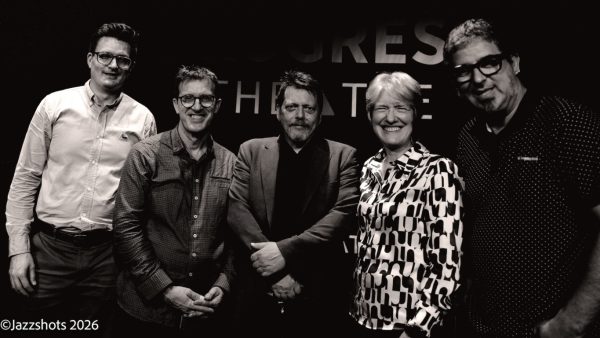
Mark Crooks tenor saxophone & clarinet | John Cervantes piano
Nigel Price guitar | Marianne Windham bass | Demi Garcia percussion
Jazz Samba! brought the irresistible spirit of Latin jazz and Bossa Nova to a sell-out audience at the Progress Theatre on Friday 1 May. Its joyful, gently swinging lyricism set toes tapping and heads swaying. If space had allowed, people would have danced. It was that kind of evening. In part a celebration of the 1962 Charlie Byrd/Stan Getz album that brought the Bossa Nova to a worldwide audience, but more importantly a tribute to the enduring influence of the Brazilian masters, like Antonio Carlos Jobin and Jao Gilberto, who created the music in the first place. Jazz Samba held us captive to the music’s magical spell.
The programme embraced the rich legacy of the ‘Great Brazilian Songbook’, covering fresh interpretations of the timeless classics ‘Corcovado’ (Quiet Nights and Quiet Stars), ‘Desifinado’ (Slightly Out of Tune) and ‘Samba de uma Nota Só’ (One Note Samba), as well as introducing a host of much less familiar (or to these ears) new material.
The cool tones of Mark Crook’s tenor sax set the evening in motion at a breezy pace with ‘Bragas Nunca Mais’ (No More Troubles). What a superb musician he is, as he further demonstrated on Jobin’s ‘Voce E Eu’ (You and Me) which featured his sublime clarinet playing and the fierily inventive guitar of Nigel Price.
Crooks also served as a genial frontman to the band. ‘This next number is quite tricky in lots of ways,’ he announced in his introduction to Jobin’s ‘Samba do Avião’ (Song of the Jet). Whatever challenges the tune presented were seamlessly navigated and a dazzling display of hand-drumming from percussionist Demi Garcia brought the house down.
Much to the delight of the audience Mark Crooks took up his clarinet again for Jobin’s beautiful ballad, ‘Retrato em Branco e Preto’ (Portrait in Black and White), with sensitive support from the rhythm section.
‘Menina Moca’ (Little Girl), a feature for pianist John Cervantes, captured the youthful charm and playful spirit of a small child to absolute perfection.
In contrast to the subtle expressions of the preceding tunes, the first set finished on a distinctly soulful note with the ‘Groovy Samba’ from Cannonball Adderley’s 1962 album ‘Cannonball’s Bossa Nova’. By all accounts Cannonball was so enthused by his introduction to Bossa Nova whilst on holiday in Brazil that he immediately assembled a group of local musicians, including future star Sergio Mendes on piano and recorded the album.
The second set opened with another piece from ‘Cannonball’s Bossa Nova’, Jao Donato’s haunting ‘Minha Saudade’ (Homesickness), the mood of nostalgia for one’s homeland underpinned by Marianne Windham’s beautiful basslines.
‘Estrada Branca’ (The Happy Madness) is one of Jobin’s earliest songs, composed in 1958 and on this occasion presented an opporutnity for a remarkable virtuosic outing for Mark Crooks on clarinet and Nigel Price on guitar. Mark Crooks used the word ‘giddy’ in his introduction … ‘and some’ I would say!
Following this up with yet another world-class performance on ‘Estate’, Nigel departed from the stage part way through the delightful ‘Chovendo na Roseira’ (The Double Rainbow) to reappear with a different instrument with even greater resonance. We began to wonder how many more guitars he had stored in the Green Room?
As one might expect with a title ‘O Pato’ that translates as ‘The Duck’, this was a ‘fun’ number which nevertheless got down to some very serious soloing with the fresh voice of the ‘new’ guitar very much to the fore.
The sensuous ballad ‘If You Never Come to Me’ has the distinction of having been recorded by Frank Sinatra in 1967 with the accompaniment of Antonio Carlos Jobin. One can understand why it figures so highly on Crooks’ list of Desert Island Discs.
The short, bluesy ‘Favela’ rounded off an evening of superb musicianship from five of the UK’s most gifted and versatile musicians. The music touched the heart, lifted the spirits, brought smiles to the face and almost, yes almost, inspired people to dance.
Our thanks to the Front of House team and all the volunteers who make it possible to present ‘live’ Jazz at Progress.
Review posted here by kind permission of Trevor Bannister
Photo by Steve Foster @jazzshots (Instagram & FB)